


02/18/2026 Exploring the Labyrinth by Kit Power: THE CAGE, essay 24
- Candace Nola

- Feb 18
- 8 min read
Exploring The Labyrinth
In this series, I will be reading every Brian Keene fiction book that has been published (and is still available in print) and then producing an essay on it. With the exception of Girl On The Glider, these essays will be based upon a first read of the books concerned. The article will assume you’ve read the book, and you should expect MASSIVE spoilers.
I hope you enjoy my voyage of discovery.
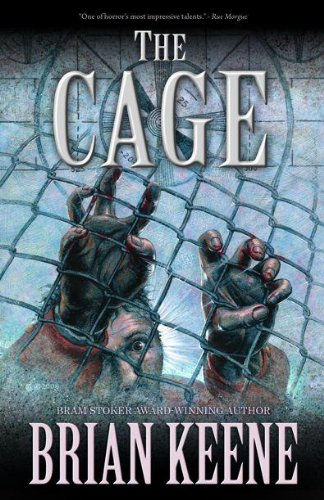
The Cage
Welcome back to Keene country.
Specifically, welcome to Big Bill’s Home Electronics, a small-town retail outlet. We’re exactly
one minute from closing time, and Jeff Cusinmano is totalling up the credit card receipts,
under the watchful eye of store owner Bill, when a man walks in with a shotgun.
And the entire evening goes immediately and decisively to hell.
Many of my longer-term readers will likely by now be bored with my continued insistence that
one of the most underrated skills in modern literature is the talented pulp writer's gift for
efficiency of storytelling, both on a sentence, word-choice prose level, and in terms of plot
and pacing. I don’t intend to belabour that point, or rehearse the argument again here;
instead, I’ll just observe that, amongst other things, The Cage is nothing less than a
masterclass for this kind of storytelling, and I love it for exactly that reason.
Take the escalation of threat, for example. By the end of page one, we’ve established a
mundane environment, familiar to millions from direct experience, and almost everyone else
by inference (because even if you’ve never worked in a store like Big Bills, you’ve sure as
hell visited one at some point, and seen the vacant eyes of the overworked till and floor staff
at the end of a long shift on their feet), to which has been introduced the terrifying figure of a
man dressed in black, holding a shotgun, with a handgun on his hip and machete strapped
to his leg.
Via Jeff’s glassy-eyed shock (which mirrored this reader's own immediate surge of fear
perfectly) we see the man ratchet up the terror, by the bottom of page two demanding the
front door be locked (meaning whatever is about to happen, it’s unlikely to be a
straightforward robbery). And when colleague Alan is understandably a little slow off the
mark in following the instruction, midway down page three, the man calmly places the
shotgun stock in his shoulder and blows a sizable portion of Alan’s head off.
Page three.
Just ten pages after that, Jeff and his co-workers are taken out to the warehouse behind the
store, and are locked together in The Cage - a secure, barred area used to house the more
valuable, easily stolen stock.
And then we spend almost the entirety of the novella sat in the cage with Jeff, as one by
one, his remaining colleagues are taken away by the killer into the store, never to be seen
again.
Now, I’ve got no objection at all to high-concept fiction, and I can enjoy such works done well
(hell, I can enjoy pretty much any genre, done well enough) but as I’m sure y’all have figured
out by now, my first love will always be a tight, claustrophobic pulp premise, preferably with a
ticking clock and ratcheting tension.
So The Cage is precision-engineered to appeal to my tastes.
I’ve been banging on since at least Terminal that I really hope there’s a straight crime novel
coming from Keene at some point. The Cage isn’t quite that… but it’s pretty damn close.
Whilst there’s clearly something deeply odd about the assailant (his ominous statement after
executing Alan that ‘he only needs six’ means a little more to the reader than it possibly can
to the other characters, who unfortunately have no idea that they’re caught up in a Brian
Keene story), and while at this point in my journey through Keene's work I could see clues
that this would tie in with a wider mythos, it’s only in the final couple of pages that anything
definitively supernatural occurs.
Up until that point, it’s just Jeff and his coworkers, trapped, frightened, with no way out,
interspersed with occasional visits from their mysterious attacker, as he takes them away
one by one back into the store, never to be seen again.
It’s a masterclass in tension; Keene spares them, and us, no mercy whatsoever, and even
as their minds rail against it, Jeff and co. on some level understand the inevitability of their
situation. Keene manages to create a fraught atmosphere in which every moment
simultaneously carries the vivid detail and weight of knowing you’re living through your last
minutes of life, whilst also feeling like that time is slipping through your fingers too fast to
grasp.
He achieves this effect by a combination of relentless pacing, note-perfect dialogue (internal
and external), and leaning into the natural rhythm of the setup, which has built in peaks of
tension as the attacker returns to the cage to take someone out, followed by valleys of time
where the remaining store workers discuss their situation.
Those characters are brilliantly realised; Keene once more displaying his apparently
unerringly deft touch in bringing blue collar subsistence living to vivid life (in the story notes,
Keene confirms he’d worked retail for two years in a similar type of store, which came as no
surprise). And the novella benefits from its grounding in a particular time and place; the fact
that the store uses Independence Day as the demonstration film for the home cinema set-up
(which the text acknowledges is already an outdated choice) contributes to the feeling that
you’re witnessing a moment trapped in amber, and being given a window into a world that’s
already all but vanished from our lives. Like all great pulp literature, The Cage is also social
commentary; not because it contains any hamfisted attempt at political commentary, but
simply because its commitment to showing what is ends up giving us a vivid snapshot of
what was.
This also comes out in the things the characters think and talk about, in the lulls between
visits from the killer; Keene captures perfectly the way the human mind veers in such
circumstances between the profound and the mundane, and one of the most heartbreaking
and on-point observations from the piece as a whole, for me, is the relative lack of anger
experienced by the victims. In the main, these men are far more fearful than furious,
desperately wishing they could just get back to their mundane normality, maybe fix or
strengthen their relationships, sure, fly a little straighter… but, I came to realise, the real
horror of The Cage is, for the most part, these men already lived there. Their horizons had
already been shrunk, by tough circumstances and the odd bad choice, such that, when
faced with the ultimate shortening of the horizon, their wishes and dreams for what might
have been are painfully shrunken, mundane.
I dunno, maybe that says more about me than them; I don’t mean to imply judgment, but it’s
hard not to come off that way. I guess I’m just trying to say I felt bad for them, even aside
from the horror of their final evening, and the cage they all (we all?) have to live in. I think
that’s part of the brilliance of pulp horror fiction, when it’s done this well; seeing how people
react when it’s too late reminds us, that it’s never too early to take stock ourselves, check
that horizon, and see how the steps we’re taking today are moving us closer towards that
place we really want to go… as well as reminding us it’s not too late now… but one day,
perhaps sooner than we realise, it will be.
One of the interesting things about this project is that it’s sometimes harder to write at length
about stories like The Cage, because they’re essentially flawless, so unless there’s details of
plot that are worth delving into or that ask deeper questions, there’s really not a whole hell of
a lot to say. The Cage is a perfect idea, flawlessly executed, and probably in my top three of
the project so far.
There are three backup stories included with The Cage. The first is Marriage Causes Cancer
in Rats. This short story starts in the same place as Terminal, with a fatal cancer diagnosis,
but the narrative soon takes an unexpected turn. This story is a great example of narrative-
as-reveal, as Keene peels away the layers around the lead character, in the process
blending in elements from The Cage and Kill Whitey. It is, in the best possible way, deeply
unpleasant, and takes a deliriously strange turn in the final few pages that push the tale into
Bizarro territory. Dark, disgusting, deranged - what’s not to love?
The second backup story is Lest Ye Become, an early story which is a graphic description of
a classroom shooting that has elements of King’s Suffer The Little Children (published in
Nightmares and Dreamscapes but written early in his career), and Rage. Keene states in the
story notes that he doesn’t think Lest Ye Become is very good. Going to have to disagree
with him there. It’s certainly unpleasant, and as someone for whom Columbine, even a
continent away, was a traumatising event, Lest Ye Become is pretty hard to stomach, given
the unflinching and graphic portrayal of gun violence against children. But that visceral
energy is what gives the story punch, and it’s clearly written by someone who understands
the wretched, destructive power of firearms. It’s a gut punch, and not one I’ll want to return to
often, but it lingers long in the memory. I think Keene doesn’t give himself enough credit for
how the story Goes There, without pity or prurience. I suspect most writers who wanted to
write this scene wouldn’t have the descriptive skill or empathy to make it land the way Keene
does.
Which may, of course, be why he doesn’t like it very much.
And finally, we have Waiting For Darkness, a flash fiction piece (the origin story for which is
Cemetery Dance asked for a story short enough to fit on a T-shirt, which is awesome). Like
Lest Ye Become, Waiting For Darkness is an absolute gut punch; a vision of the kind of hell
basically any of us could fall into at any moment. Like the title story, it’s about claustrophobia
and inevitability, and it’s brilliant.
Next up, we’re revisiting Cryptid country with Scratch (and backup story Halves).
KP
5/4/25
PRE-ORDER VOLUME 1 OF EXPLORING THE LABYRINTH NOW!
Exploring The Labyrinth Volume One collects the first 30 essays in this series, and features an introduction by Eric LaRocca, and an intimate, exclusive, career spanning interview with Brian Keene.
Order now to get your copy on October 13th: http://mybook.to/KPETL
LINKS TO WORKS BY BRIAN KEENE:
Order Brian Keene books and many other indie horror titles direct from Vortex Books:
Missing a Keene title and can't find it on Vortex, check out his Amazon page:
BIO FOR KIT POWER:
Kit Power is an author of horror and dark crime fiction novels, novellas, and short stories, also a reviewer, essayist, and podcaster. The Finite, A Song For The End (BFA finalist, 2021), and Millionaire’s Day (BFA finalist, 2025) are his most recent fiction works; three novellas with interconnected elements that bring the apocalypse to his hometown of Milton Keynes in three very different ways. He encourages you not to read too much into that.
When he’s not gleefully visiting destruction on his hometown (fictionally), Kit writes non-fiction (much of which is collected in the two-volume My Life In Horror tomes, available wherever books are sold), reviews, blogs, and podcasts on subjects as diverse as Sherlock Holmes, Bruce Springsteen, and short horror fiction.
And if you enjoyed what you just read, please back his Patreon and buy his damn books, because the man needs to eat. Thanks.
Find Kit at the below links:
Find his podcast feed at https://talkingrobocop.libsyn.com/
Find his Patreon (free membership gets you the newsletter, as little as a $1 a month gets something new every week) at: Kit Power | creating Blog posts, Podcasts, Reviews, and Stories long and sho | Patreon
Find him on Bluesky: @kitgonzo.bsky.social


Comments