


09/23/2026 Exploring the Labyrinth by Kit Power: THE DAMNED HIGHWAY, essay 31

Exploring The Labyrinth
In this series, I will be reading every Brian Keene fiction book that has been published (and is still available in print) and then producing an essay on it. With the exception of Girl On The Glider, these essays will be based upon a first read of the books concerned. The article will assume you’ve read the book, and you should expect MASSIVE spoilers.
I hope you enjoy my voyage of discovery.
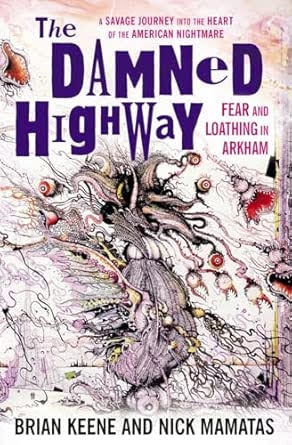
THE DAMNED HIGHWAY
Essay 31
Welcome back.
As I type, the month of December is dragging arse, and this gold-plated dumpster fire of a year is finally, blessedly beginning to flame out - though I wouldn’t put it past 2025 to take a couple of my beloved rock icons or directors or authors on its way out the door, just to remind me who’s boss (and lo, in-between the first draft and publication date, no less an icon than Rob Reiner has left us. RIP, the man who bought us the character who brought us Kramer Vs Kramer Vs Godzilla, You brought joy, and you will be missed). Regular readers will know that I started 2025 married and am finishing it divorced, living in my late father’s house, which I’m in the process of filling out a seemingly endless avalanche of forms (and paying an endless parade of £400 - £700 solicitor bills per month, apparently, because everyone just has that kind of money lying around) for the privilege of earning a third of the value of the sale price, in order to buy another house, the mortgage for which will see me on a mainly noodle-based diet, at least until such time as my kid makes it to University, and potentially way beyond that.
I am, as ever, trying to say positive, and there have, fortunately, been some causes for optimism over the last 12 months; still, on reflection, 2025 can kiss my flabby, leaky arse. Twice.
I start with this written equivalent of verbal diarrhoea because, frankly, the subject of the essay demands it. Regular readers will already be bored by my insistence that, whatever the many flaws of Hunter S Thompson as a human being (and there were many), he remains a vitally important figure because of his bug-eyed, furious insistence that the notion of objectivity in non-fiction writing is a colossal, dangerous lie sold to us by shit-breathed liars for the express purpose of laundering their lies. And whatever else he was wrong about, he was fucking right about that.
So, this essay series doesn’t exist in anything remotely resembling its current form without the not-entirely-wholesome-but-definitely-1000%-righteous influence of the good doctor.
And neither does the work of Brian Keene.
Keene’s been upfront and vocal about his love of Dr Thompson's work on many occasions down the years, and I believe he still reads Thompson's only novel, The Rum Diary, once a year, just to check in with the source. The Rum Diary is an interesting novel in that it’s written in pretty much the same first-person voice as Thompson's non-fiction (though the novel does admittedly rein in some of his more excessive eccentricities). I’m sure more scholarly minds than mine have speculated about the degree to which the novel is a novel, and to what degree a veiled confessional. I can’t resist adding that one of Thompson's favourite novels was The Great Gatsby, and, according to the doctor's retelling of his own legend, he once typed out the whole novel over a period of a few weeks, just to understand what the physical experience of writing it would feel like - and there are some Gatsby type themes in The Rum Diary, albeit it told through a startlingly different lens, setting, and voice.
So when Keene had described The Damned Highway as a loving tribute by himself and co-author Nick Mamatas to, and in the style of, the good Doctor, I was both excited and curious. It wasn’t immediately clear to me how Hunter’s style/voice was adaptable at all, never mind in the context of a Lovecraftian mythos novel. All kinds of obstacles and challenges presented themselves to my imagination; Hunter’s voice is powerful, compelling… but also deliberately, aggressively problematic at times (not a phrase in use when he was writing, but an accurate description; Thompson delighted in being an equal opportunities offender and took his role as unofficial courtroom jester to US society very seriously). Would it work at all, outside the bounds of the time and place he was writing (some of Thompson's later work suggests, sadly, maybe not - or at least not entirely)? And while Thompson's use of various narcotic and psychedelic substances was the stuff of (self-mythologising) legend, would a Thompson-style character work in a Lovecraft-type story? And might we not end up with something that felt like a pastiche of Warren Ellis' Transmetropolitan, and his own fictionalised reincarnation of Thompson, Spider Jerusalem?
I mean, it’s Keene, and it’s Mamatas, so I wasn’t without hope. But I had anxieties, and I was prepared for something… unusual.
I was not remotely prepared enough.
For starters, this isn’t ‘in the style’ of Thompson; The Damned Highway is represented as a missing volume from the canon of the man himself. Specifically, (confirmed in the afterword, but I’m enough of a fan that I’d worked it out quite early on in the novel, an absolutely euphoric moment), The Damned Highway takes place during the period in Fear and Loathing on the Campaign Trail when our fearless reporter experienced an emotional and mental breakdown that took him entirely out of commission for several weeks (leading to a classic Hunter intro to the original book, where he’s writing the final pages of the book in a hotel room, jacked up on amphetamines, while minions from the publishing house feed the pages into a precursor to a fax machine, to get them out into the book on time; classic Hunter, in other words).
Ballsy does not even begin to describe this move. It’s one thing to do what Ellis did; take the trappings and voice of the man and transplant them to (effectively) Mega City One, apply heat and simmer. But to instead take us back to the moment in Thompson's own biography where his considerable talents and prodigious, ostentatious substance abuse crashed headlong into the spectacle of the McGovern Vs Nixon campaign, the moment from which, arguably, neither his body, mind, nor career ever fully recovered?
Because …Campaign Trail is a raw, difficult read, if you’re a Thompson fan. The guy was, to put it mildly, a prickly character, but he also had a raw charisma on the page that made him feel sympathetic, if not always straightforwardly likeable, and I always had to admire his willingness to write nakedly, even if I didn’t always like what he revealed by doing so. So seeing his deterioration happening on the page, as a combination of aggressive drug use and his own considerable political acumen and intelligence reveals to him, almost against his own will (and certainly against his strong political preferences) that the unthinkable - a second Nixon term - is tipping from probable to inevitable, is honestly kind of heartbreaking.
And here, lobbed like the holy hand grenade of Antioch by the grinning anarchists Keene and Mamatas, comes The Damned Highway.
Let’s start with this; they absolutely nail the voice. I was politely sceptical going in, but within a few pages, I’d become a believer. This is note-perfect Thomson; cadence, sentence structure, word choice… hell, the narrative even does the classic Thompson thing of veering between the self-aggrandising and the dark confessional, paragraph to paragraph. Similarly, the Lovecraftian elements fit in far better than I’d expected, purely because they’re viewed entirely through Hunter’s sceptical yet drug-addled brain. So, we don’t get too much of Lovecraft’s ‘things man what not meant to wot of’ vibe; instead, we get Thomson’s ferocious self-belief, coupled with his journalistic instincts, incapable of self-doubt, no matter how insane the picture becomes (again, Thomosns real life experience with hallucinogenic substances, and his gift for writing about his perceptions while on them, is a significant benefit for the writers, here).
And intellectually I get it, I think; there’s enough of Thompson's words out there that, if you close read, and really think about not just what he does but how he does it, it should be possible to capture it. But, well, two things; I can imagine getting close, but I can’t imagine getting this close. I’ve not read everything Thompson put out, but I’ve sampled work from most eras of his career, and I’m telling you it’s goodman eerie how close Keene and Mamatas get to the man’s voice here. It becomes especially apparent in the final chapter, when a much older Thompson is reflecting on the story contained in the main manuscript, and the voice is different; it becomes the sadder, older voice of his later work, riddled with pain, sensing the end of the road fast approaching. It’s an incredible artistic achievement, and I’m honestly in awe of it.
But also… how on earth do you do this with two writers? I cannot begin to unpick a process that could have led to this seamless a manuscript being produced (and you can bet, when we get to Exploring The Labyrinth Volume Two's inevitable interview, I am going to have some questions). I can only imagine that both writers had a bone-deep understanding of, and love for, Thompson’s prose - it’s almost the only way it could have worked.
I’m conscious I haven’t talked much about the narrative yet. I guess my reasoning is simple enough; there is one, and it’s an absolute belter, but as good as it is, it’s not really the story that had me reading most of the book with my jaw unhinged. I mean, it does what would make sense to do if you were colliding Lovecraftian mythos with the ‘72 Presidential campaign and Hunter S Thompson, the political commentary is depressingly on point (and, as with many such works, in 2025 even feels depressingly prescient - there were people who saw the current moment coming, and I do rather wish we’d listened to them a little closer a lot earlier). And it’s a genuine delight to read a narrative where Thomson's deranged yet fiercely self-confident mind is brought into conflict with the cosmic horror beastery, in part because he responds exactly as you’d expect; furiously and fearlessly, wasting not a second doubting the power of his senses, even when under the influence of mysterious psychotropic substances.
That said, what I mainly got from the book was - and I realise how truly weird this will sound, but - a kind of dumbfounded gratitude.
Because it was like getting to spend a bit more time with an old friend whose time has passed.
No, I know, I know. But… that’s how good the ventriloquist act The Damned Highway pulls off is. Or, it was for me, anyway. I got to read a new Hunter S Thompson book, written at the time when he was, arguably, at the absolute peak of his powers (sure, whilst teetering on the brink of collapse, and I don’t agree with the man that it’s that space that always produces the best work, but I do acknowledge that, in Thompson’s case, there was an undeniable dark alchemy at work in the man’s mind as it balanced precariously on the edge of drug and stress induced breakdown). And the experience was genuinely moving. I kept waiting for the spell to break, looking out for the cute wink to the camera or lazy turn of phrase that would tip the book into pastiche and break the spell… and it kept not happening.
It’s funny, I recently had the joy of seeing Black Sabbitch (a US-based all-woman Black Sabbath tribute act) with my daughter, and the feelings I experienced were remarkably similar. The fidelity of the artists to the source material, coupled with the power of a live performance, had the weirdest effect of making me fall even more in love with Sabbath than I already was - which really shouldn’t have been medically possible. It was a transcendent evening of live music, and if they ever come to your town, don’t hesitate to grab a ticket.
Of course, seeing Black Sabbitch isn’t the same as seeing Black Sabbath… but the ship has, finally, irrevocably sailed, hasn’t it? If you were lucky enough to be there, good for you, but either way, Sabbath have performed for the last time. So, Black Sabbitch have become (IMO) the closest thing to that experience that you can now find. And, again, IMO, not only is that not nothing, it’s a pretty big, powerful something all its own; a sense of renewal and immortality all in one, the live show an act of devotion, respect, and love that keeps this vital band and their vital music part of the living present, as well as reminding those of us who were there and those of us who weren’t the enormous power of live Sabbath.
And that’s what The Damned Highway felt like to me; a note-perfect rendition of classic Hunter S Thompson. Not merely a respectful tribute, but something akin to reverence (albeit with a healthy fuck-you attitude that one can't help but feel the man himself would approve of). And it achieved something that, before reading it, I would have flatly and with some confidence told you was impossible; it gave me something that felt like new Thompson… no, better even than that; an unearthed Thomson from the height of his imperial phase, all bile, fury, fear and loathing, glaring into the abyss before cackling with manic glee and tossing a Molotov cocktail down there, just to see what would happen.
I had no idea Keene or Mamatas had anything like this in them. I had no idea something like this was even possible. It’s got me thinking all over again about writing and how it works and why. It’s got me hungry for more Thompson. And it’s got me fired the fuck up; for this project, for my own fiction, for grabbing hold of life and taking a big fat bite and chew and masticate and swallow.
Absolutely fucking astonishing.
Thanks, gents. Next rounds on me.
Next up: A return to the watery apocalypse, with Earthworm Gods II: Deluge
KP
14/12/25
ORDER VOLUME 1 OF EXPLORING THE LABYRINTH NOW!
Exploring The Labyrinth Volume One collects the first 30 essays in this series, and features an introduction by Eric LaRocca, and an intimate, exclusive, career spanning interview with Brian Keene.
Order now to get your copy on October 13th: http://mybook.to/KPETL
LINKS TO WORKS BY BRIAN KEENE:
Order Brian Keene books and many other indie horror titles direct from Vortex Books:
Missing a Keene title and can't find it on Vortex, check out his Amazon page:
BIO FOR KIT POWER:
Kit Power is an author of horror and dark crime fiction novels, novellas, and short stories, also a reviewer, essayist, and podcaster. The Finite, A Song For The End (BFA finalist, 2021), and Millionaire’s Day (BFA finalist, 2025) are his most recent fiction works; three novellas with interconnected elements that bring the apocalypse to his hometown of Milton Keynes in three very different ways. He encourages you not to read too much into that.
When he’s not gleefully visiting destruction on his hometown (fictionally), Kit writes non-fiction (much of which is collected in the two-volume My Life In Horror tomes, available wherever books are sold), reviews, blogs, and podcasts on subjects as diverse as Sherlock Holmes, Bruce Springsteen, and short horror fiction.
And if you enjoyed what you just read, please back his Patreon and buy his damn books, because the man needs to eat. Thanks.
Find Kit at the below links:
Find his podcast feed at https://talkingrobocop.libsyn.com/
Find his Patreon (free membership gets you the newsletter, as little as a $1 a month gets something new every week) at: Kit Power | creating Blog posts, Podcasts, Reviews, and Stories long and sho | Patreon
Find him on Bluesky: @kitgonzo.bsky.social


Comments